# Incredigo
**No plaintext at rest.** Decrypted secrets live only in locked, non-swappable RAM; on disk they're GPG-encrypted in gopass.
*Local-first, encrypted, RAM-only credential custody — shipped as the `incredigo` CLI.*
## Vision
**Incredigo** — an **incred**ible **cred**ential rotation automation, **i**n **Go**.
> How long would it take to rotate *every* credential on your machine?
> Honestly, I get kinda sick just thinking about it.
The design has **two parts**:
1. **The everyday user** who reuses the same password everywhere — with this tool as
the driver behind a managed security service.
2. **A concept/framework for *ethical* research** into a novel kind of worm: one that
can find and edit credentials to help it spread more rapidly.
**Where it starts:** the secrets developers create that are changeable straight from the
command line. *(Current status: early-stage dev — the `cyber-malware-path`.)*
**The end goal:** pair browser automation with machine learning to automate
browser-based password resets. *(The `mass-consumer-market`.)*
I have faith this could be lucrative for the community. I wasn't planning on
open-sourcing it — but I realized I really want help and collaboration.
*Malware bless — technicals below.*
```
+------------------------------------------------------------+
| /\ INCREDIGO |
| /<>\ in-CRED-i-GO : credentials, in Go |
| \<>/ Decrypted secrets live in locked RAM. |
| \/ No plaintext at rest; encrypted on disk. |
+------------------------------------------------------------+
```
Incredigo finds credentials scattered across the usual places
(`~/.aws/credentials`, `.env` files, `~/.netrc`, SSH keys,
`~/.docker/config.json`, kubeconfig, gitea/git tokens…), custodies them in a
[gopass](https://www.gopass.pw/) (GPG-backed) store **without ever writing
plaintext to disk**, tells you which ones are stale, **rotates what's
scriptable**, and hands you a guided worklist for the rest.
- 🔒 **No plaintext at rest.** Disk only ever holds GPG blobs (gopass) or
sealed backups (age / hmac / openssl).
- 🧠 **RAM-only secrets.** Decrypted material lives in `mlock`'d, non-dumpable,
zeroized memory ([memguard](https://github.com/awnumar/memguard)).
- 👀 **Read-only discovery.** Scanners never touch your source files.
- ♻️ **Backup-gated rotation.** No rotation runs without a verified sealed backup
first; new secret is proven to authenticate before the old one is revoked.
- 🧩 **Hackable.** A new scanner, sealer, or rotation driver is one file each.
See [`DESIGN.md`](DESIGN.md) for architecture + threat model,
[`VISION.md`](VISION.md) for who it's for, and [`docs/MARKET.md`](docs/MARKET.md)
for positioning.
## Who it's for
The **vibe coder** — the fast-moving AI-assisted builder who ships in a weekend
and accumulates dozens of credentials (`.env` keys, `sk_live`, `DATABASE_URL`,
GitHub PATs, AWS keys) each *generated once, pasted in, and never rotated*.
Incredigo finds that sprawl, custodies it, backs it up, rotates what's scriptable,
and guides the human through the rest — before a forgotten key becomes a breach.
## Status (2026-07)
**v1 custody pipeline: done.** discover → RAM vault → migrate → status →
sealed export/import. 9 scanners; sealers age (default) / hmac / openssl.
**Rotation: 22 drivers + wired Mode A `--execute` spine.** All self-register.
`rotate --execute` runs only behind `INCREDIGO_ALLOW_EXECUTE=1` **and** a
mandatory verified-backup gate, and only drivers proven against real target
software run by default.
Proof status is tracked as **data** ([`internal/rotate/proofs.go`](internal/rotate/proofs.go),
mirrored in [`docs/ROTATION-PROOFS.md`](docs/ROTATION-PROOFS.md), surfaced as a
`PROOF` column in the CLI):
| Level | Count | Meaning |
|---|---|---|
| **LIVE-VM** | 8 | cutover proven against **real** target software in a sandbox VM: postgres, mysql, redis, mongo, wireguard, gitea, appsecret, k8s |
| **MOCK-ONLY** | 14 | proven only against an emulator/mock (httptest, moto): aws, sshkey, openwrt, mullvad, cloudflare, ghactions, gitlab, npm, gcp, twilio, flyio, resend, vercel, sendgrid |
| **LIVE-REAL** | 0 | **no real, host-owned credential has ever been rotated** — this remains gated behind explicit per-credential authorization |
**Guided manual layer: done.** `incredigo worklist` / `incredigo guide` (TUI)
emit a secrets-free checklist of change-URLs (49 curated sites + RFC 8615).
**Phase B (password-manager / browser turnover): scaffolded, not wired.** 12
adapters + pwgen + staging exist; `passwords pw-*` flow is incomplete.
Tests: **247 pass, `-race` clean, 13 packages.** Coverage highlights: vault/worklist
100%, policy 95%, sink 85%, tui 88%; `cmd/incredigo` (34%) is the weakest and the
next test target.
## Build
Requires Go 1.22+.
```sh
go build ./cmd/incredigo # or: make build
go test -race ./... # 247 tests, -race clean
```
## Usage
```sh
incredigo scan --dry-run # see what's out there (no secrets printed)
incredigo migrate --prefix imported/ --dedupe # custody into gopass, no plaintext on disk
incredigo status # age vs policy
incredigo export --out ~/incredigo-backup.age # sealed backup (age)
incredigo worklist --out rotate.md # guided checklist for manual rotations
incredigo guide # TUI walk-through of the worklist
# rotation (Mode A — rotate what's already in gopass):
incredigo rotate --dry-run --prefix imported/ --blast # plan + blast radius, touches nothing
INCREDIGO_ALLOW_EXECUTE=1 incredigo rotate --execute --prefix imported/
```
`--execute` is refused unless `INCREDIGO_ALLOW_EXECUTE=1` is set; it always runs
the backup gate first, and skips any driver whose proof is below `LIVE-VM` unless
you pass `--allow-mock-proven`.
## Reproduce the LIVE-VM proofs
The 8 `LIVE-VM` claims are reproducible from a clean machine — see
[`lab/README.md`](lab/README.md). The scripts stand up **real** target software
(PostgreSQL, MariaDB, redis, mongod, wireguard, Gitea, k3s) in a throwaway VM and
rotate **fake** credentials in an **isolated** gopass store. Nothing there can
touch a real store or provider.
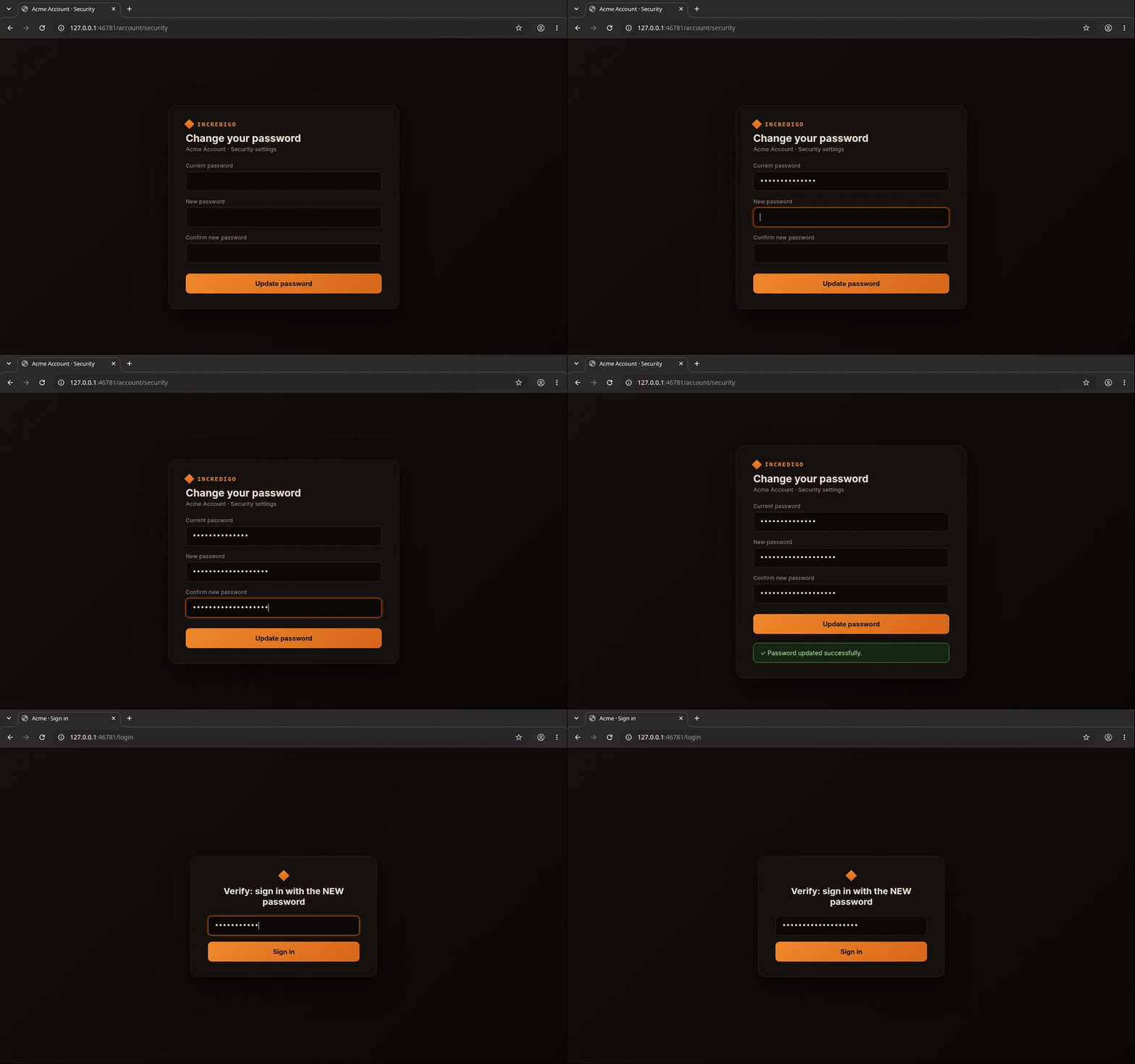
## Browser-based rotation (Phase A engine)
The site-side rotation engine ([`internal/browserrot`](internal/browserrot)) drives a
**real** headless Chromium end-to-end — no language model in the loop: